Rate for service
September 2, 2026
.jpeg)
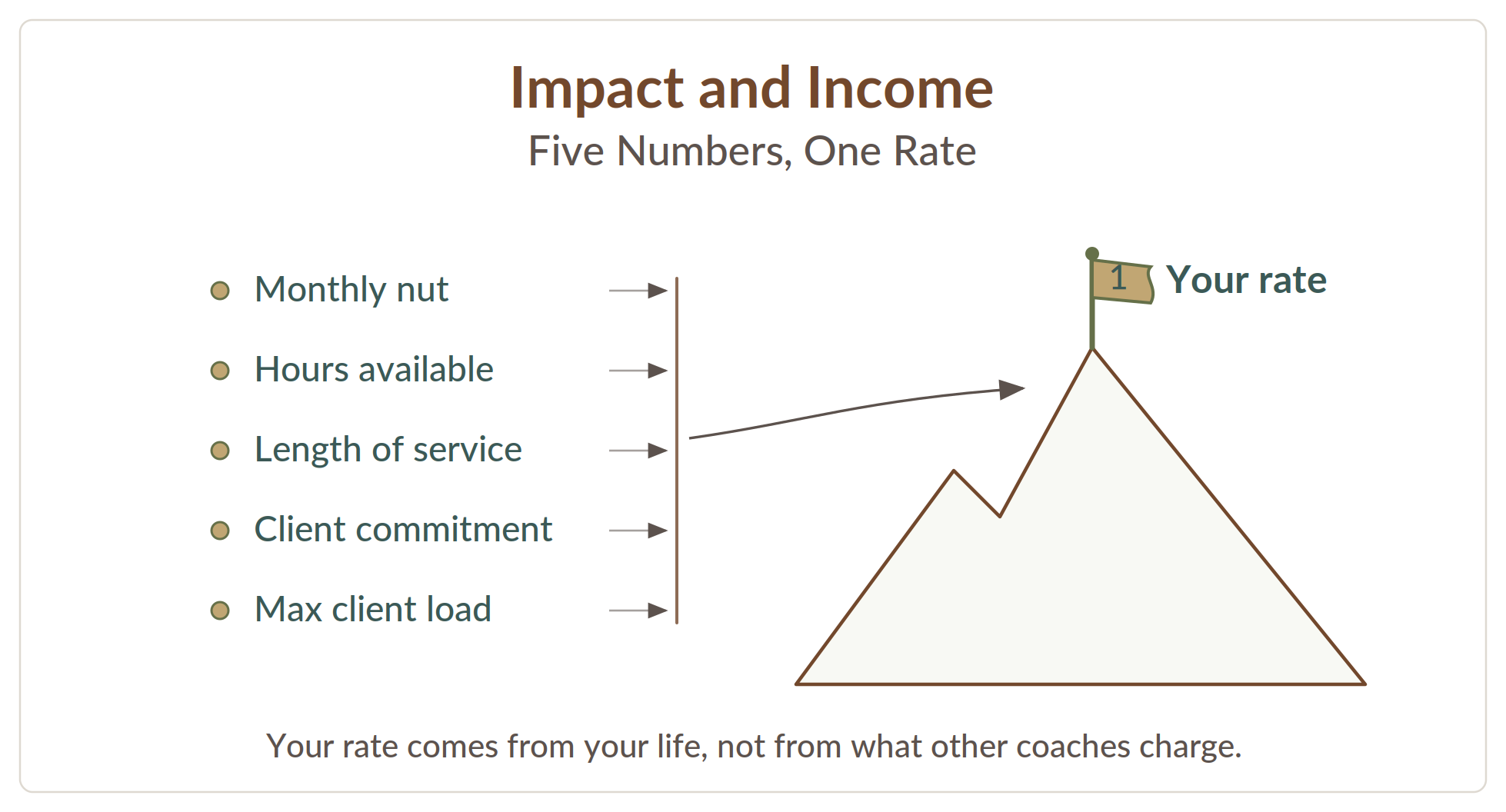
Impact and Income Blog Series, Post #3.
Setting your rate is one of the first business decisions you make as a coach, and most of us make it by guessing. We look at what other coaches charge, or what a therapist down the road charges, and we land on a number that feels safe. There is a more grounded place to start: what your life costs you each month. Everything in this post builds from that number. You will want a pen and a calculator.
Key takeaways:
- Your rate starts from your monthly nut, the bare-bones cost of your monthly expenses. Not from what other coaches charge.
- Five variables build the rate: your monthly nut, monthly hours available, estimated length of service, monthly client commitment, and max client load.
- Max client load is your monthly hours available divided by the hours each client takes per month. Monthly nut divided by that load gives what one client pays per month.
- Trading dollars for hours does not work for a coach who is starting out. It puts far too many clients on your calendar.
- Aim for a smaller client load and a higher-value service. This is about raising value, not cutting price.
- Gut check every number you land on. Your rate should motivate you, not terrify you.
The first milestone to reach on your journey to a thriving coaching business is to be able to generate enough income from your coaching work to cover your "monthly nut" - your bare-bones cost of monthly expenses.
That monthly nut is a real-life dollar amount, with real-life adult consequences if it's not met. So if we are to be professional coaches who are out there in the world helping others thrive in their lives, we need to, at the very least, know that we can keep a roof over our own heads, right?
If not, we won't be able to serve others well because we'll be too focused on our own survival.
When you're an employee working for a corporation, you are trading your time, skills, attention and energy for the money it takes to make ends meet. As a coach and entrepreneur, you are trading a service (your unique service that is designed to help your clients achieve the transformation they're seeking) for the money to make those ends meet.
So, wouldn't it make perfect sense for the rate of your service to be influenced by the cost of your monthly nut? And, wouldn't you want to ensure that you can cover that monthly cost with as few clients as possible?
Most coaches don't think this way when they are starting out. They have no real reference for how to think about rate and their service other than the status quo, or maybe what therapists are charging. But as coaches, we're not therapists, nor a substitute for therapy, and the service you want to offer as a Nature-Connected Coach is certainly not the status quo!
You're not a "super-coach" either, who can defy physics and not need to eat! You are just like all the other humans out there with real-life human needs, but what makes you different is that you have an important gift to share with the world, and you've decided to act on it.
The rate for your service, at this stage in the process (remember, you are working towards the first milestone) has to be based on your real-life human needs.
I'll get into this more in a future post, but when you think about your individual timeline, what we are doing here is finding a way to move the funding of your monthly expenses from Income A (your current employment) to Income B (your coaching business), so you can start to feel comfortable and see a future where you can turn off Income A.
And, since Income A is taking up most of your time and energy, we have to find a way to do this with as little time and energy as possible. Determining the rate for service starts to clear the path toward this.
There are two parts to the process of creating a rate for service so you can start to map your timeline to a thriving coaching business. There is a bit of a formula here, and in the first part, we need to determine the different variables. In the second part, we put them all together to find the rate. It's easy and only takes a few minutes.
Part 1: Determining the Variables
Step 1: Your Monthly Nut
What is your monthly nut? Calculate the expenses that you would like to have your coaching service pay for as soon as possible. For example, imagine if your food, mortgage/rent, and utilities were all covered by your coaching clients. What would become possible for you?
Are there other essential expenses that must be covered as well? Gas, insurance, etc.
Note: If you're in a partnership that splits expenses, just focus on your portion right now.
What is your monthly nut? Write it down.
Example: My Monthly Nut is: $4200 ($50,400/year)
Step 2: Monthly Hours Available
If you were to start seeing clients tomorrow, how many hours do you have available each week to work with them? Look at your schedule over the next year or so and consider essential scheduling demands like work, family, and education. How many hours in a month can you confidently set aside for clients on average? This number is called your Monthly Hours Available.
Example: My monthly availability is 27 hours
So in this example, I have 27 hours a month to generate $4200. At this point, it's easy to look at those numbers in a conventional way and think, "If I'm trading hours for dollars, that's $155 per hour, paid by 27 clients."
Not an unreasonable rate, but 27 clients is a lot of clients! And that raises all sorts of questions and overwhelm about how to find them, doesn't it? That's because the dollars-for-hours model is not the right approach for a coach who is just starting out.
There are many reasons why that approach is not sustainable, but that will need to be the subject of a different article. For now, I want to challenge you to think outside of the box with me. Let's keep going.
Step 3: Estimated Length of Service
So you've identified your monthly nut and the number of hours you realistically have available to coach each month.
Now comes the fun part! Envision the service you want to offer people. How would you love to be working with them? Are you out in nature? As you imagine this, think about the transformational journey you want to help them take, and the outcome you want them to have.
Change doesn't happen overnight, right? Make a guess at how many months you think will be required for dedicated clients to reach that outcome.
At this point you only need an estimate. You'll refine this number later after you understand more about your service, which is actually part of the process of growing your business. If you are seeing a range of time (for example, 8-10 months), choose the more conservative number. Write that number down. This is your estimated length of service.
Example: I want to help young men who are struggling to launch find direction and purpose and build momentum in their lives so they can be successful. I think I will need 10 months to really help this client achieve that outcome. My length of service: 10 months
Step 4: Monthly Client Commitment
If you had a client sign on with you for 10 months, how many hours a month of your time do you think will be required to help them maintain steady progress toward the outcome they want? Write that number down. This is your monthly client commitment number.
Example: My monthly client commitment is 4 hours
If you get stuck here, a phone call with one of us at EBI can come in handy because we can give you a good sense of what other NCC's are doing.
Step 5: Determine your max client load
Sticking with the example, we now know that my service is going to require each client to commit to 40 hours of coaching over the course of 10 months. We also know that, of the 27 hours I have available each month to give my clients, each one is going to take 4 of those hours. And this gives us a very important number: Your Max Client Load. This is the maximum number of clients you can work with at any given time in order to give them the highest-quality service.
To determine your Max Client Load, divide your monthly availability hours by the monthly client commitment hours. Write that number down (round up).
Example: [27 hours (monthly availability) ÷ 4 (client commitment hours) = 6.75 max clients]
My Max Client Load is 7 clients
Step 6: Finding the Initial Service Value
I use the word "initial" here because we are not done honing in on your Ideal Service Rate. Stick with me!
Currently, in my example, the next step is to take your monthly nut and divide it by your max client load, which then shows you what each client needs to pay you a month.
In my example, it looks like this: $4200 (monthly nut) ÷ 7 (max client load) = $600/month
We can multiply that number by our Length of Service and see the Initial Service Value of the service I want to offer.
Example: $600/month (client monthly rate) x 10 months (length of service) = $6000 (Initial Service Value)
What's cool about this is that value is not a random number that you pulled out of the sky. That is actually based on your real needs as a human being and a professional.
Example: My Initial Service Value is $6,000 or $600/month
So, now I know two very important things:
- I need to find 7 families with young men struggling to launch who are looking for help and can afford to pay $6000 either all at once or over 10 months.
- I need to have a service that delivers a higher value than $6000. This is an important sales concept to consider.
Why higher value? We all love to feel like we are getting the most out of every dollar we spend. And it's easier to ask someone to pay $6000 for something that is worth $10,000!
We now have all the variables we need to determine your Ideal Rate for Service that is based on your real life needs. Let's put it all together!
The balancing act here is that this is not about reducing the price. This is about increasing the value. Many new coaches fall into the price-reduction trap, thinking they can get more clients if they offer a cheaper service than the other coach next door.
Well, you might get more clients, but you won't make more money. Remember, you have limited time and energy to help those clients and earn the money you need to cover your expenses.
Instead, I like to think about how I can reduce my client load and find the value number that inspires me to be great, rather than terrifies me and makes me want to run to the hills. In the end, whatever numbers I end up with will be my Ideal Client Target and Ideal Service Rate. Let's start crunching numbers!
Part 2: Balancing the client load and finding your Ideal Service rate.
Please remember, everyone's situation is different and the numbers I'm using here are just examples. The clientele you hope to work with as a Nature-Connected Coach could be a business that makes millions of dollars a month and can easily afford to invest in their executive team. Landing one client contract like that could meet your financial goals for the next 10 months. Or, you might be more interested in working with teachers who are going to be more conscientious about the return on their investment. Either way, it's the same process.
When it comes to client load, I like smaller numbers.
This does three things:
- It reduces the number of clients you need to find, which is great because you have limited time and energy due to your commitments with Income A.
- It pushes you to create an incredible, high-value service.
- It also allows you to give your clients a lot of personalized attention, which makes the service even more valuable.
In Part 1, you determined your Max Client Load. The process ahead helps you hone in on the smallest number of clients possible, and the associated Ideal Service Rate!
As you "run the numbers," be sure to cross-reference the results with a "gut check." Does that number feel motivating, terrifying or impartial? You want your Ideal Service Rate to feel motivating and inspiring!
Example: In part 1, we determined my Max Client Load of 7. Let's run the numbers to feel into other options and see if we can get that any lower.
Let's try 3 clients:
- $4200 (monthly nut) ÷ 3 (max clients) = $1400/month x 10 months (commitment length) = $14,000 (total service value).
- Gut check: Wow, I'm not sure I can get myself to ask someone for $14K at this stage. That's too much.
Let's try 5 clients:
- $4200 (monthly nut) ÷ 5 (max clients) = $840/month x 10 months (commitment length) = $8400 (total service value).
- Gut check: That's feeling better, but maybe a little out of reach for me, value-wise, at this point.
Let's look at 6 clients:
- $4200 (monthly nut) ÷ 6 (max clients) = $700/month x 10 months (commitment length) = $7000 (total service value).
- Gut check: That feels like the sweet spot where I feel like the number inspires me to create something of high value.
I'm going for it!
- My Ideal Client Load is 6.
- My Ideal Service Rate is $7000 for 10 months of coaching.
- The Monthly Nut I need to cover is $4200, which is $50,400 a year.
- With 6 clients in the books, I'll earn $42,000.
- I'm still $8400 short to cover the whole year, but that gets covered completely when I sign on clients 7 and 8 ($7000 x 2 = $14,000).
- With some thoughtful strategic planning, I could actually generate $56,000 or more in my first year of business!
How to do that strategic planning will be found in future posts.
I know my ideal client load and rate for service, now what?!
So, now you know the process and can determine what your rate for service needs to be! From there, you can start focusing on creating a service that meets that value requirement. You also know how many clients you need to find to feel like you've got momentum in your coaching business.
Now that you know this, you can ask two more important questions to help you plan accordingly:
- How do I find these clients and create a steady referral stream so I can sustain the Monthly Nut coverage until I'm ready to move to Milestone #2?
- How do I create a service that offers a higher value than the amount I'm asking for?
The second question is the more important question of the two, because the more confidence you have in the value your services bring, the easier it is to find clients and ask for the money.
This is where an accredited certification program comes into the picture. Obtaining a credential as a Professional Coach immediately boosts your credibility!
If you are looking for a nature-focused approach to coaching, our Nature-Connected Coaching Certification program offers you a unique and highly effective coaching model for helping clients reach their goals. It is rooted in deep nature awareness practices and the neuroscience of change, and it provides you with an internationally-recognized professional credential. It is also easily modifiable so you can make it your own and meet the high-value your clients expect.
If this is what you're looking for, your next step is to apply! If you're accepted, we'll help you start building your coaching business right away so you can start seeing clients as soon as possible.
As always, if you would like any personal support in determining your individualized timeline to Milestone 1, schedule a free snapshot call.
Oh, and by the way, the answer to that first question (how to find the clients) will come in my next blog post. So keep your eyes open for that!
FAQ
How do I set my coaching rate as a new coach?
Start from your monthly expenses, not from what other coaches charge. Work out five numbers: your monthly nut, the hours you have available each month, how many months your service runs, how many hours each client takes per month, and the resulting max client load. Then divide your monthly nut by that client load.
What is a monthly nut?
Your bare-bones cost of monthly expenses. Food, rent or mortgage, utilities, and other essentials like gas and insurance. If you split expenses with a partner, count only your portion.
Why not just charge by the hour?
Run the math and you can see why. With $4,200 to earn and 27 hours a month available, hourly billing works out to $155 an hour paid by 27 separate clients. That is a lot of clients to find and serve. The dollars-for-hours model is not the right approach for a coach who is starting out.
How do I work out my max client load?
Divide your monthly hours available by the hours each client takes per month, then round up. In the worked example, 27 hours divided by 4 hours per client gives 6.75, so the max client load is 7.
How long should my coaching service run?
Estimate how many months a dedicated client needs to reach the outcome you are aiming for. If you land on a range such as 8 to 10 months, choose the more conservative number. You can refine it later as your service takes shape.
Should I lower my price to get more clients?
No. Many new coaches fall into the price-reduction trap. You might get more clients, but you will not make more money, because your time and energy are limited. Raise the value instead.
What if my rate feels too high to ask for?
Do a gut check on each number. Run the math at different client loads and notice which one motivates you rather than terrifies you. In the worked example, $14,000 felt like too much and $7,000 felt like the sweet spot.
Why should my service be worth more than what I charge?
Because people want to feel they are getting the most out of every dollar. It is easier to ask someone to pay $6,000 for something worth $10,000.
Become a certified Nature-Connected Coach
If you'd like to learn more about NCC and talk to someone about your individualized timeline and roadmap you can schedule a Snapshot Meeting.
Apply to the Nature-Connected Coaching Certification
Michael Jospe, PCC, is the founder and lead instructor of Earth-Based Institute, an ICF Level 2 accredited Nature-Connected Coaching certification program based in Boulder, Colorado. He has been an ICF-credentialed coach for over two decades and has trained hundreds of professional coaches since 2008.
%20(1).png)

.png)