August 7, 2026
.jpeg)

Prefer to watch? There's a video at the bottom of this post where I walk through the whole framework.
My guess is that there's a deeper reason you want to work with clients outdoors than a change of scenery from a boring office. I'd bet it goes deeper than the potential for adventure, movement, and challenge, and maybe even deeper than the physiological and stress reduction benefits. Those reasons are all great. But if you're like me, the pull to work with clients outdoors is connected to something more core, more primal, and more about the insights and healing that only nature can provide.
Coaching outdoors and on the land has the potential to be transformational and life changing for your clients. Creating that experience, though, is more involved than moving your sessions outside. A normal, run of the mill coaching session won't work out there. Without a framework, your session runs the risk of feeling like an everyday coaching session that would have happened inside, except now it's happening under a tree.
I've been teaching coaches to close that gap since 2008. I'm Michael Jospe, founder of Earth-Based Institute and creator of the Nature-Connected Coaching Certification Program, and I've trained hundreds of nature connected coaches in this method.
Key takeaways:
There are always benefits to being outside. And there is a big difference between sitting outside under a tree having a coaching session and accessing the depth of transformation and healing that we know is accessible in our relationship to nature.
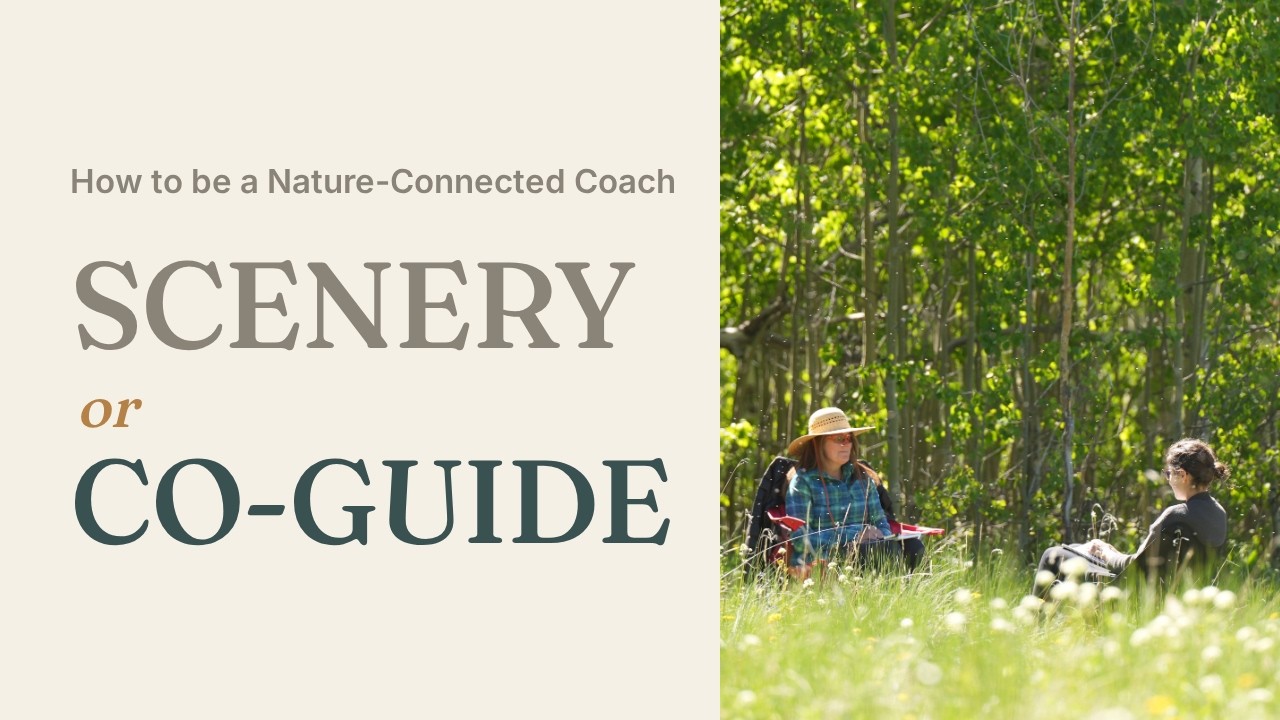
The difference is not the location. It's whether you invite your client to engage with the environment. Without that invitation, nature stays scenery, and the session could have happened indoors.
To put this into perspective, think about our relationship to nature in three levels.
Level one is transactional. Nature is a backdrop, a venue, a place you go out to for exercise or adventure. You're in a beautiful place you love, and it's wonderful to be there, but you're not making any sort of connection.
Level two is therapeutic. This is where forest bathing and forest therapy live. You start to access the physiological and psychological benefits of being on the land, which are well documented in peer-reviewed research. You know this level because you've experienced it yourself.
And that's probably one of the reasons you're called into this work: to help other people experience that same depth.
Level three is transformational, and this is the realm of nature-connected coaching. These are the deep breakthrough moments in a life that are influenced by nature. You've most likely lived this yourself, whether in a single vivid moment or built slowly over years on the land. In this shift of perspective, nature almost becomes an active participant in your process, like a guide. It's almost as if nature is listening to what you're saying, how you're being, how you're acting and responding. Nature becomes a reflective source of truth.
At level one, nature is where the session happens. At level three, nature becomes a co-coach with you and with your client. That's where we want our coaching sessions to get to.
The process I teach my Nature-Connected Coaching students works whether the session is out on the land, indoors, or on Zoom. It moves through three stages, and the stages are sequential. The first one sets up everything that follows.
Intention here is more than words. Forming an intention follows a neurological process, and it primes your mind and your body for the next moments.
Think about why somebody comes to coaching in the first place. They want to change some aspect of the experience they're having. That day-to-day experience is built on beliefs, patterns, attitudes, and behaviors that were useful at one point and no longer serve them. Their brain has been formulating intentions for them all along, based on what was originally programmed as important. Now the person is saying: I want to do life differently.
But there's a problem. We can't create a new intention from an old way of being. We have to move beyond the old stories of ourselves to create it. That's what this first stage of the session is about: moving beyond the old stories and into a new intention.
Once your client has that intention, the transformational relationship with nature kicks in. You take the new intention out onto the land, or into whatever environment you're in, and your client begins to notice new things about themselves. In the past, they engaged with their environment from an old way of being. Now they get to ask: how is the environment responding to me now?
This rests on a concept: your way of being in this moment has a presence, and that presence has an impact on your environment. You've noticed somebody walk into a room and change it just by being there. Your client has that same impact. When they change their way of being, they carry a different presence. A different presence creates a different impact, and that impact is what they get to learn from.
So the invitation in this stage is to stop thinking about the new way of being and become it. Try it on. The only way to learn is to try. That's how information turns into wisdom.
It takes a tremendous amount of trust on everyone's part, because your client is walking into the unknown. And the unknown is where the magic happens: novelty and attention are what jumpstart the change process in the brain. When somebody willingly walks into an unknown experience, it creates the prime condition for the brain and the mind to evolve. Your client starts to look at nature through new eyes, which immediately invites nature in as an active participant. That tree you're sitting under is now something different in their mind, and the more they tune into that, the more they learn about their new way of being.
One practical note on setting. A wild natural location is ideal in many ways, because there's so much nature can reflect back. But any environment will do. What matters more is the difference between neutral and non-neutral environments. A natural setting is neutral, and it gives your client a lot to work with. A home, a workplace, a social situation: those come with pre-programmed triggers that activate the old self very quickly. The more your client practices with you in a neutral environment, the more the neural connections of the new self strengthen before they walk back into the non-neutral ones.
Which is exactly what happens right after the session ends, and it's the whole point of stage three.
Change can't hold in someone's life if the way their brain processes information doesn't change with it.
One of the greatest gifts of our brain is efficiency. Staying focused and attentive takes a lot of energy, so the brain moves most decisions down into the unconscious, where they run on autopilot. That same efficiency is what keeps your client in their comfort zone, their default mode. What they want is for that default to become a different pattern. That takes consistent attention: getting ahead of the brain's tendency to tuck decisions back into the unconscious.
In a standard coaching session, the end result we strive for is the to-do list. In nature-connected coaching, our focus is on who is doing the to-do list, which matters more than what's on it. It's really a to-be list.
Say one of the to-dos is cleaning out the garage to make way for new space. Great. Who is going to clean out that garage: the old way of being, or the new one? Talk to the boss, talk to the partner, get to the gym more. All good things to do, and they may be exactly what living the new life looks like. But who is going to do them?
So in this final stage, you help your client create clear, meaningful opportunities to practice their new way of being in real time, in their life. The more they stay engaged that way, the more the new self embeds and starts to become the default. The brain learns through repetition that this new way of being is what matters now. We're not working against how the brain works. We're working with it.
Your coaching session is their first opportunity to practice.
In a normal coaching session, you can feel a lot of pressure to have the answers for your clients, to have the next question ready, to come up with a solution. Especially when a client isn't fully clear and engaged, which happens quite a bit.
When you bring your client into a transformational relationship with nature, everything shifts in terms of how much energy you're putting in. You become more of a mediator between nature and your client. You're holding the space rather than working hard to help your client make certain connections. Those connections come quickly and easily when your client is in that state. Once you start applying this framework, the amount of work you end up doing in a coaching session drops significantly.
This is where you start to hear the kind of thing Sara, one of our graduates, heard from a client recently: "I got more out of that one coaching session than I have in four months of therapy."
These stages aren't something I invented. When I started to research what was going on in this work, I found they come from two places that turn out to describe the same thing.
One is ancestral wisdom: the patterns in how people have related to nature for generations, the rituals and practices that keep showing up across cultures and still matter today. The other is the neuroscience of change: how the brain and the mind actually shift from one way of being into another.
Put them side by side and you begin to see it. Our nature connected ancestors were already following the process that neuroscience is describing today. They were listening to how change actually happens inside us. They just didn't call it neuroscience. They called it ceremony, or ritual. These stages are something I noticed, where ancient practices and modern science meet, and I've spent the years since 2008 teaching coaches to work with them deliberately.
You learn this process the same way your clients do: by trying it, starting with yourself. So before your next session, whether it happens outdoors, indoors, or on Zoom, sit with these questions:
All of this is already wired into you, and it's already wired into your client's brain. It's already a part of nature. Trust that process, try it, and you'll learn the different steps and how to do them well.
Nature will show you.
No. A wild natural location is ideal in many ways because of how much nature can reflect back to your client, but any environment will do. It's about experimenting, moving, and being more than anything else.
Yes. The same three-stage process creates that atmosphere whether your sessions are indoors, on Zoom, or out on the land. I teach my students to run it in all three.
Whether you invite your client to engage with the environment. If nature stays a backdrop, you have a normal session in a nice location. When your client engages with the environment from a new way of being, nature becomes an active participant in the session.
The stages sit where the two meet. Ancestral practices across cultures were already following the process that the neuroscience of change describes today. They called it ceremony or ritual rather than neuroscience.
Of course not. That's why people hire a coach: to help them stay on track and on top of this change in their life. The brain learns through repetition that the new way of being is what matters now.
Try it. The best way to master the art is to practice it, and all of it is already wired into you. If you want hands-on mentoring and a professional credential as a nature connected coach, that's what our certification program is for.
If you'd like one-on-one mentoring, a professional credential as a nature connected coach, and a community of nature focused coaches and guides, take a look at the Nature-Connected Coaching Certification Program.
About the program: Nature-Connected Coaching is ICF Level 2 accredited coaching education, 315 hours. Students are certified in about 12 months and credential-ready in one to two years, depending on experience hours. The program exceeds the education requirements for an ICF PCC credential and includes two years of close, individualized business mentoring to help you launch your coaching business.
Download the Nature-Connected Coaching brochure →
Want to see the work first? Watch the video this post comes from, or start with What is Nature Connected Coaching and At the Heart of Nature Connected Coaching.
Michael Jospe, PCC, is the founder and lead instructor of Earth-Based Institute, an ICF Level 2 accredited Nature-Connected Coaching certification program based in Boulder, Colorado. He has been an ICF-credentialed coach for over two decades and has trained hundreds of professional coaches since 2008.
[00:00:00] My guess is that there is a deeper reason for why you want to work with clients outdoors than just a change of scenery from a boring office. I bet it goes deeper than the potential for adventure, movement and challenge, and maybe even deeper than the physiological and stress reduction benefits.
[00:00:24] And you know, while those reasons are all great, if you're like me, the pull to work with clients outdoors is connected to something even more core, more primal, and more about the powerful insights and healing that only nature can provide.
[00:00:42] Coaching outdoors and on the land has the potential to be transformational and life changing for your clients, but to create that experience is more involved than simply moving your coaching sessions outdoors.
[00:00:57] In fact, a normal run of the mill coaching session won't work. And in this video I'm gonna give you a framework to follow that does work, and I know it works because I've trained hundreds of nature connected coaches in this method since 2008. My name's Michael Jospe. I'm the founder of the Earth-Based Institute and the creator of the Nature Connected Coaching Certification Program.
[00:01:21] So if you're currently working with clients, I want to help you take your outdoor coaching sessions to the next level. Or if you're still trying to visualize how you might help someone benefit from the power of nature, this video will give you a framework to follow.
[00:01:37] And without this framework, your sessions run the risk of feeling like a normal everyday coaching session that would happen inside, but instead it's just happening outside under a tree. And of course there's always benefits to being outside, but there is a big difference between just sitting outside under a tree and having a coaching session and accessing the depth of transformation and healing that we know is accessible in our relationship to nature. To help put this into perspective, I want you to think about our relationship to nature in three different levels.
[00:02:14] Level one is more of that transactional level where nature is like a backdrop. It's a venue, it's a place that you go out to, to exercise in. You have an adventure in, but you're not really making any sort of connection out there, and in a beautiful place that you love and it's wonderful to be out there.
[00:02:35] The next level is more of a therapeutic experience or relationship with nature. This would fit more into forest bathing or forest therapy or something like that, where we're really starting to access the physiological and psychological benefits of being out on the land, which is proven and there's just a tremendous amount of benefit behind it. And you know that because you've experienced it yourself, and it's probably one of the reasons why you're called into this work, is to help other people experience that same depth.
[00:03:10] But there's something even deeper than that, and this is really the realm of nature connected coaching.
[00:03:17] This next level of relationship is what we call the transformational relationship. And this is where we have those deep breakthrough moments in our life that are influenced by nature, and you've most likely experienced this yourself, and it could be part of the reason why you want to share nature in this way with other people.
[00:03:41] And it's in this shift of perspective where nature almost becomes like an active participant in your process, like a guide. And it can kind of leave you a little bit puzzled about what is happening, but it's almost as if nature is listening to what you're saying and how you're being, and how you're acting and responding.
[00:04:03] And it's like nature almost becomes this reflective source of truth, and this is where we want to be able to get to in our coaching sessions with our clients.
[00:04:15] So you can see a huge difference between a transactional relationship, which would be like sitting under a tree and having a coaching session, into this transformational relationship where nature becomes an active participant in the coaching session, becomes a co-coach with you and with your client.
[00:04:35] So let's talk about the process for getting your coaching sessions to that point. And this is the same process that I teach all my nature connected coaching students, so they're able to create that atmosphere in their coaching sessions, whether those are indoors and on Zoom or out on the land.
[00:04:53] So if you've been looking for a place to learn this type of work, check out Earth-Based Institute. If you'd like one on one hands-on mentoring and training, a professional credential as a nature connected coach, and to be part of a community of amazing nature focused coaches and guides, check out our Nature Connected Coaching program.
[00:05:16] In the description below, there's a link to download our brochure and reach out to us to find out when our next cohort starts.
[00:05:25] Okay. I am excited to share this process with you because when you get into this depth of experience with your clients, this is where you're going to hear things like what Sara, who is one of our graduates, heard from one of her clients recently: "I got more out of that one coaching session than I have in four months of therapy."
[00:05:46] So there are three steps, three stages to a nature connected coaching session, and these stages are sequential. So it's really important that you go through this first stage right, because it sets you up for the rest of the coaching session. And what I love about this is that once you figure this out and you start applying it, you'll quickly realize that the amount of work that you end up having to do in a coaching session drops significantly.
[00:06:13] You know, in a normal coaching session, you might find yourself feeling really pressured to have the answers for your clients or the next question to ask them, and feeling like you've gotta be able to come up with a solution.
[00:06:26] And you can feel a lot of pressure, especially if your clients aren't fully clear and engaged as, you know, a very active participant in your coaching session, which happens quite a bit. And when you start to bring nature in, you start to bring your client into that transformational relationship with nature.
[00:06:46] Everything shifts in terms of how much energy you're putting into this experience, and when that shift happens, you're more of a mediator between nature and your client.
[00:06:59] You're someone who is holding the space rather than working really hard to help your client make certain connections.
[00:07:06] Those connections come very quickly and very easily when you're in this transformational state.
[00:07:13] Now before we get into it, one important thing. These steps aren't random, and when I started to really research what was going on here, I realized that they come from two places that turned out to be describing the same thing. One is ancestral wisdom, the patterns and how people have related to nature for generations.
[00:07:37] The rituals and the practices that keep showing up across cultures and still matter today. The other is the neuroscience of change and how the brain and the mind actually shift from one way of being into another, and you put these side by side and you begin to see it. Our nature connected ancestors were already following the process that neuroscience is describing today.
[00:08:05] They were listening to how change actually happens inside us. They just didn't call it neuroscience. They called it ceremony or ritual or something like that. So these steps aren't something I invented. They're something I noticed where ancient practices and modern science meet.
[00:08:22] So the goal of this first stage is about intention. Now, I'm not gonna get into the details of intention in this video, but what I want to say is that it's not just words. There's a process of forming intention that is actually following a neurological process, and that is an important thing to remember as we start going down this road of nature connected coaching.
[00:08:48] Start to think about intention as a way of priming your mind and your body for the next moments.
[00:08:56] When you think about why somebody is coming to coaching in the first place, it's because they're wanting to change some aspect of the experience that they're having, and that day-to-day experience is based on the beliefs and the patterns and attitudes and behaviors that at one point were useful and helpful, but in some way, today, they're no longer serving them. Now there's some aspect of themselves that's saying, hey, this is no longer working. And what's been happening is that the brain and the mind has been formulating an intention for that person to step into the next moment, but based on what's originally been programmed as important, and now the person is saying, I want to do life differently.
[00:09:46] So we're asking for a new intention. We wanna prime the brain in a new way, but there's a problem with this because we can't create the new intention from an old way of being. We have to actually move beyond the old stories of ourselves to create it, and that's what this first stage in the coaching session is all about.
[00:10:10] It's about moving beyond those old stories and into a new intention. And in a future video, I'll explain more of the finer details and steps that are part of this process for forming intention in the way that I'm referring to here, because there's actually a lot to it. But since you're following a natural process that your brain goes through, in fact, you've gone through this many, many times already in your life, you're gonna eventually discover those different steps and stages.
[00:10:39] As long as you keep connected to this process, you're gonna figure it out on your own. And I'll come back to do another video at some point that will help you kind of move quicker through that learning curve. But once you have that intention, you can start to move into the next stage of the coaching session, and this is really where the transformational relationship with nature kicks in.
[00:11:03] This is where we experiment. We take that new intention out onto the land or into whatever environment we're in, and we begin to notice new things about ourselves. Because in the past we were engaging with our environment from an old way of being. Now we're engaging with it from a new way of being. So we get to ask, how does nature, how does the environment respond to us now? How is the environment reacting to us?
[00:11:31] Now, this is based on a really important concept that your way of being in this moment has a presence, and that presence has an impact on the environment. Think about it. You've noticed somebody walk into a room and just their presence changes the room, right?
[00:11:51] You have that same impact. Your old way of being has been having an impact on your environment all along, and your environment has been responding to you around that presence. So when you change your way of being, you have a different presence, and a different presence creates a different impact.
[00:12:12] That impact is what we get to learn from. And so what we wanna do is experiment with this new way of being. We wanna get into it, we want to embody it, we wanna stop thinking about it and become it.
[00:12:27] The whole process of moving into intention was so we could experience something new in our lives.
[00:12:33] We want to drop the conversation and the talking about and thinking about, and we want to go and be it. We want to try it on. The only way to really learn is to try. That's how we can turn information into wisdom. And it's exactly what I hope you do with this information here, 'cause I'm giving you information, I'm giving you some knowledge, and I want you to try so you can turn that into more of an embodied wisdom. And that's the same concept that we're trying to invite our clients to do in this stage: they've developed some knowledge about how they want to be in the world, and so now they get to try it on.
[00:13:18] And in doing this, it requires a tremendous amount of trust on everyone's part because what you're doing is going into the unknown. And the unknown is where all of the magic happens, because novelty and attention is what jumpstarts the change process in the brain.
[00:13:36] When somebody willingly walks into an unknown experience, it creates the prime condition for the brain and the mind to start to evolve. This is, in essence, the transformational relationship that I was referring to.
[00:13:53] Your client starts to look at nature and their experience through new eyes, which immediately invites nature in as an active participant in their learning process, because that tree that you're sitting under is now something different in their mind. It's experienced in a different way.
[00:14:13] The more they allow themselves to tune into how they are experiencing that tree in a new way, they learn more about this new way of being. As they start engaging with the environment in this new way, they are naturally going to begin to feel more connected to the land from this new way of being, and that becomes a really important resource for them moving forward.
[00:14:37] But like I said before, it doesn't have to be out in nature. A natural landscape is ideal in many ways because there's so much that nature can reflect and is reflecting back to the client. But any environment will do, and really it's about experimenting, moving, being than anything else.
[00:14:56] The more challenging the environment in terms of how it relates to the old self, the more the new way gets to be embedded into that environment.
[00:15:06] So just to say, a wild natural location is a neutral environment and it has a lot of really valuable data. A non neutral environment like a home, a work environment, a social situation, they come with some pre-programmed triggers that activate the old self very quickly. So the more your client gets to practice with you in the context of your coaching session in a neutral environment, the better, because it helps strengthen the neural connections that are associated with that new self.
[00:15:44] Before going out into the world, before going out into those non-neutral environments, which is gonna happen right after that coaching session and is the whole point of our third stage.
[00:15:58] And this third stage is so important because change can't hold in someone's life if they don't change the way their brain is processing the information and energy.
[00:16:10] One of the greatest gifts of our brain is efficiency.
[00:16:14] You see, it takes a lot of energy to stay focused and attentive to what's happening in the moment. So your brain has a way of moving most of your decisions and experience down into your unconscious, where it can run on autopilot and make those decisions on your behalf.
[00:16:32] You don't have to spend that extra energy, but that same efficiency is what's keeping us in our comfort zone. It's what's keeping us in our default mode. And what we want, what our clients want, is for that default mode, that highly efficient, almost unconscious processing, to change, for it to become a different pattern.
[00:16:55] And that takes consistent attention and focus. It means getting ahead of your brain's natural tendency to tuck those decisions back down into the unconscious. So in this last stage of your coaching session, we want to help our clients create opportunities to keep experimenting and practicing this new way of being in real time in their life.
[00:17:20] Now in a standard coaching session, the end result that we're often striving for is to get to that to-do list. But in nature connected coaching, we're talking about something that's quite different. There's a little bit more depth to the actions that your client is going to go do than from a standard to-do list.
[00:17:44] We're not really talking about a to-do list at all. Our focus is more on who is doing the to-do list. That is more important than what the to-do list has on it. It's really a to-be list.
[00:17:58] So let's say one of the to-dos is, I've gotta clean out the garage and make way for new space in my life. Great. From our perspective as a nature connected coach, who is gonna clean out that garage? Is it the old way of being or is it the new way of being? Or let's say on that to-do list is, I've gotta talk to my boss, or I've gotta talk to my partner, I've gotta get to the gym more, or something like that.
[00:18:23] Those are all good things to do, and they may be exactly what living this new life looks like. But who is gonna do them? Is it the old self or the new self? That is the opportunity we want to bring into this final stage. We want to help our clients create clear and meaningful opportunities to practice and experiment with their new way of being in the world in real time and in their life.
[00:18:50] And the more they keep themselves engaged that way, the more that new self embeds and starts to become the default. Think of your coaching session as their first opportunity to practice this.
[00:19:04] And that's the whole loop here. The brain's efficiency is what's locked in the old way of being, and the efficiency is what's gonna lock in the new way of being.
[00:19:15] But the brain has to learn again and again, through repetition, that this new way of being is what is important now. We're not working against how the brain works, we're working with the brain.
[00:19:27] Does this happen overnight? Of course not. That's why people hire you as a coach, to help them stay on track and on top of this change in their life. Just like with all the other stages of the session, there's an art to helping your clients move through these different stages effectively.
[00:19:47] And the best way to learn this, the best way to master that art, is to try it.
[00:19:54] Remember that all of this is already wired into you and it's already wired into your client's brain. It is already a part of nature, and all you need to do is trust that process and you will learn all of the different steps and how to do it really well.
[00:20:13] Nature will show you.
[00:20:15] And if you'd like to be credentialed as a nature connected coach and be part of a professional community, remember to check out the Earth-Based Institute, download our brochure and get in touch with us. The link for all that is below.
%20(1).png)