August 14, 2026
.jpeg)
Prefer to read? The written version starts just below.
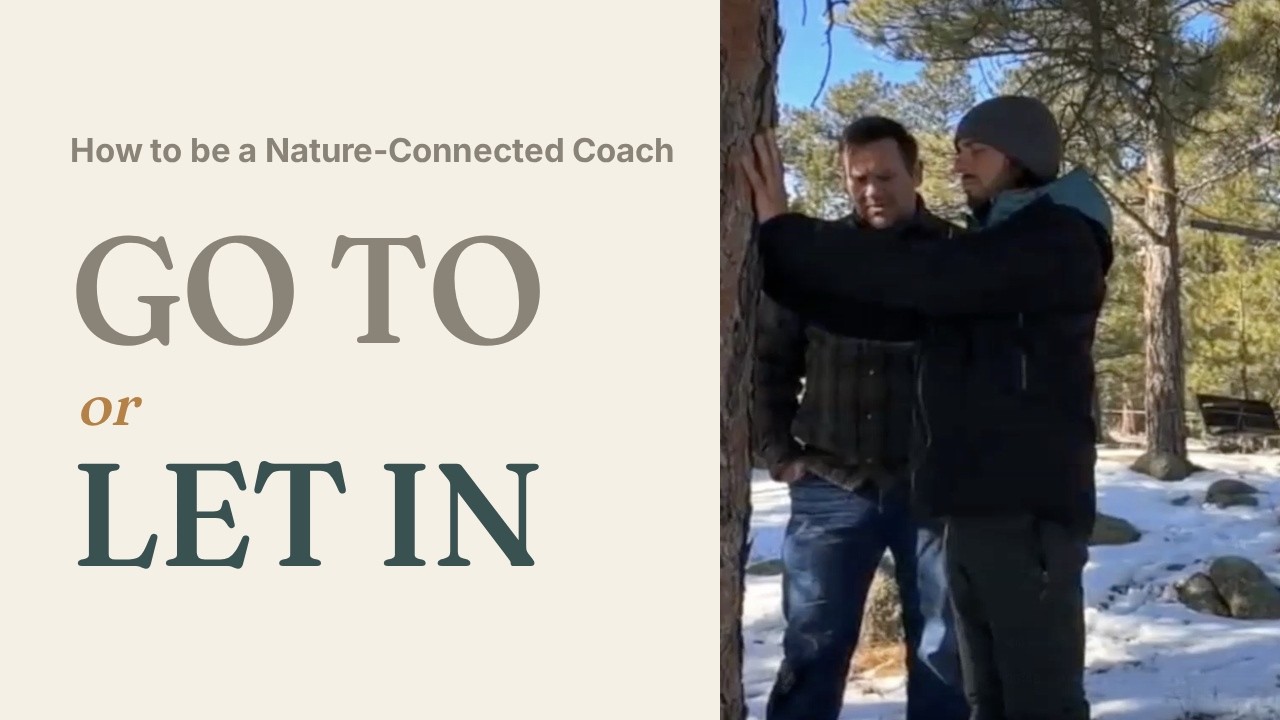
The mistake I see a lot of outdoor coaches make is that they think they have to sell nature to their clients. You find yourself explaining why it's important to be outside, and justifying why sessions should happen outdoors.
There's no reason to sell nature.
When I first started Earth-Based Institute and the Nature-Connected Coaching Program, my mentors would ask me how I was going to sell nature. It never lined up in my head. How are you supposed to sell nature? Nature is everywhere. Nature is everything.
What the video covers
Adventure and wilderness experiences, wilderness therapy, and forest bathing and forest therapy all bring clients out to a place for a specific purpose. Those are powerful and effective methodologies. They're just different from Nature-Connected Coaching.
The concept that put this together for me came out of my wilderness survival and primitive living background: Nature will always provide. The way to approach Nature from this perspective is always from a place of trust. That's probably the most challenging skill set to develop as a coach: trusting that nature is everywhere, that nature will provide, and that your client is nature.
Test it where you're sitting. Look at the phone or the computer you're on right now and consider how the technology of these things comes from nature. Look around the room you're in and you'll see that everything in it comes from nature. You are nature. Your clients are nature.
Once that lands there's nothing to sell, because there's nowhere to take anyone. If we can connect with a client's innate wisdom, they have all the answers, the same way nature will provide.
The other concept comes from Gestalt therapy. What I love about Gestalt is that it's about embodiment, and about engaging with what's arising right now in the present moment. It shifts the experience from thinking about something into being with it.
To do that you have to go into the unknown. We don't know what we're going to experience, and we don't know what the outcome of that experience will be. That's uncomfortable, because your clients came for an outcome and there's a high expectation placed on you as a coach. The skill worth developing is showing up to that expectation while staying open to the unknown, then inviting your client into it in a way where they can see how it's moving them toward their goals.
There's always a time for thinking about and talking about. But for a session to shift from transactional into something more transformational, it has to shift from talking about to being with.
The wilderness locations and outdoor locations you want to bring your clients to are powerful, and those places are important, because there's something there. They can reflect your client's own wisdom back to them, and that's indispensable.
Think of place as an enhancement. And no matter where you are, the work is always about trust, being with, and your ability to stay present with your client in the unknown.
No. If you're convincing, you're treating nature as an add-on that has to justify itself. Nature is already in the room and already in your client. The work is letting it in rather than arguing for it.
No. Wilderness therapy, adventure programs, and forest therapy bring a client to a specific place for a specific purpose, and the place is part of the intervention. Coaching operates in a different context and doesn't depend on getting anyone anywhere.
Yes. Everything around you comes from nature, including the room you're in and the technology in your hand. A park, a field, or a tree at the end of the block gives you something to work with, and so does an indoor session or a call.
It means you don't have to manufacture the material. Your client's own wisdom and whatever environment you're in will supply what the session needs. Your job is to trust that and stay present.
That's the condition, not a problem to solve. The skill is holding your client's expectation of an outcome while staying open, and inviting them into the unknown in a way that still moves them toward their goals.
If you'd like one-on-one mentoring, a professional credential as a nature connected coach, and a community of coaches and guides exploring this way of working, take a look at the Nature-Connected Coaching Certification Program.
About the program: Nature-Connected Coaching is ICF Level 2 accredited coaching education, 315 hours. Students are certified in about 14 months and credential-ready in one to two years, depending on their professional experience and how quickly they complete the ICF requirements. The program exceeds the education requirements for an ICF PCC credential and includes two years of close, individualized business mentoring to help you launch your coaching business.
Download the Nature-Connected Coaching brochure →
New here? Start with why moving your sessions outside isn't enough, which walks through the three stages of a nature-connected coaching session.
Michael Jospe, PCC, is the founder and lead instructor of Earth-Based Institute, an ICF Level 2 accredited Nature-Connected Coaching certification program based in Boulder, Colorado. He has been an ICF-credentialed coach for over two decades and has trained hundreds of professional coaches since 2008.
%20(1).png)
Earth-Based Institute is an ICF Level 2-accredited training organization. We've certified Nature-Connected Coaches since 2008, alongside offering programs for personal growth, leadership, and 1:1 coaching.
[email protected].png)